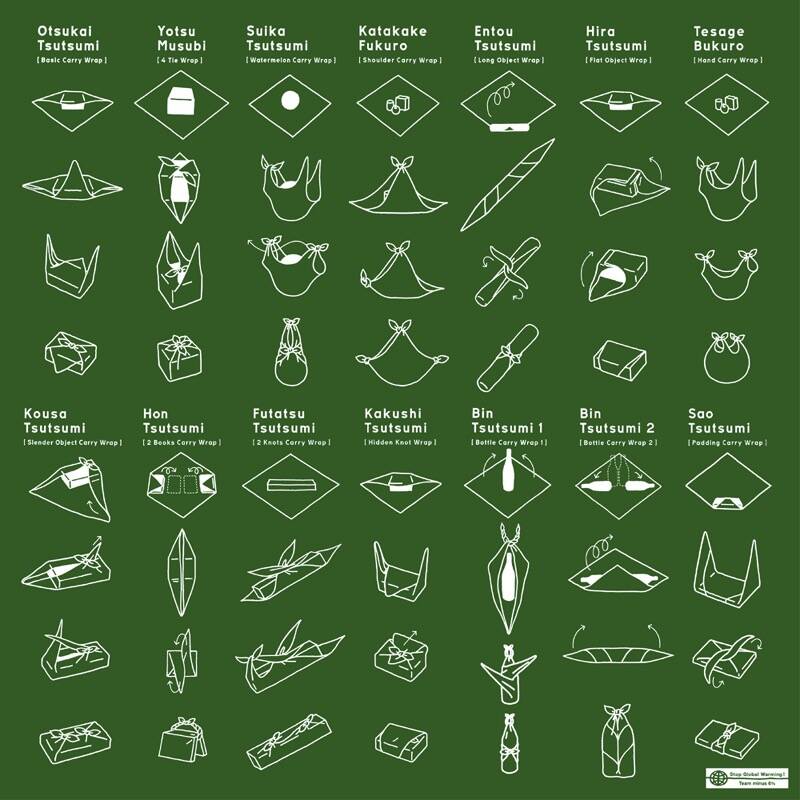
When it comes to the holidays, and gift-giving in general, instead of shelling out money for wrapping paper and tape or gift bags and tissue paper, consider something more personal and eco-friendly: the Japanese art of furoshiki, where gifts are wrapped with folded and knotted fabric that is both reusable and beautiful.
In early December, the Seattle Consulate-General of Japan partnered with the King County Library System to put on a class called “Fabulous Furoshiki: A New Twist on an Old Idea” at the Woodinville Library.
Led by Lynn Shiori Miyauchi, the Consulate’s Senior Specialist for Cultural Affairs Sister Cities & Public Outreach, everyone in the class was provided with empty bottles, empty DVD cases, medium-sized sports balls and a furoshiki with bright colors and cute designs on one side.
“The size can vary from very small to as large as a tablecloth,” she said.
Originally created to carry precious items using just a square piece of cloth, Miyauchi explained that furoshiki went out of fashion in the 1960s and 1970s when plastic bags quickly became the norm for carrying items.
“Furoshiki is popular again because now we realize that maybe [plastic bags] aren’t best for the environment,” Miyauchi said with a laugh.
Since reusable grocery bags have risen in style, furoshiki has evolved into its new and unique function as a gift-wrap.
“It only takes two knots, which are called musubi. One knot is called musubi-hitotsu and a square knot is ma-musubi,” said Miyauchi, adding that the only limitation to using furoshiki is the size of the object one wants to wrap in relation to the cloth and one’s own imagination.
Along with teaching us the proper ways to wrap different items, Miyauchi showed us the different ways to use furoshiki to safely and securely carry plates and food containers, which would especially come in handy when bringing home holiday leftovers and delivering desserts.
Wrapping with Furoshiki
The simplest way to wrap a square gift is known as the “otsukai tsutsumi,” where the furoshiki is laid flat and oriented into a diamond shape, with the bright design side facing down.
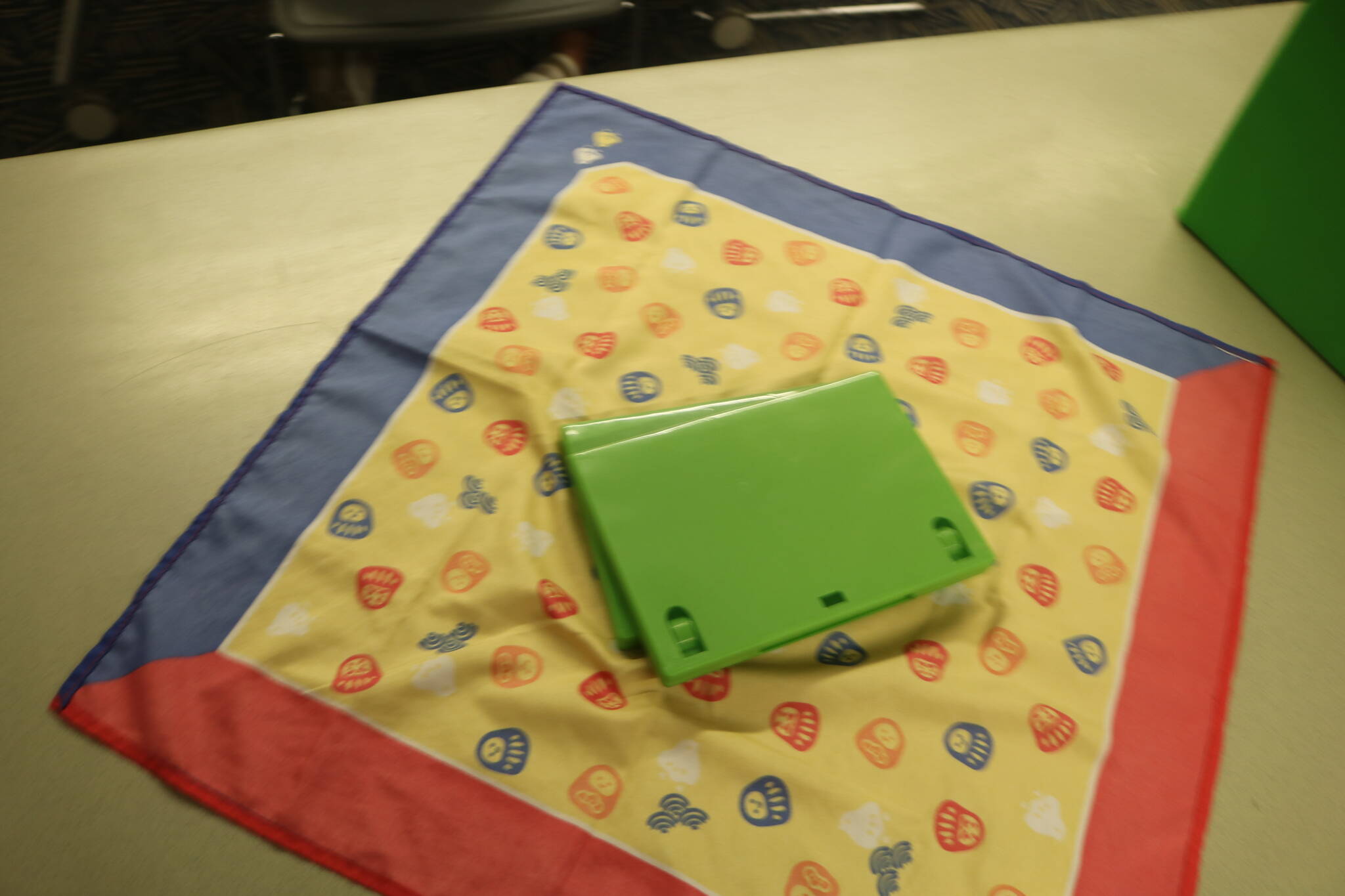
Photos by Bailey Jo Josie/Sound Publishing.
Once the furoshiki is ready, place the item or box into the center and fold the top corner of the diamond down, covering the gift item. Then, fold the opposite corner up, with the end hanging over as a lip.
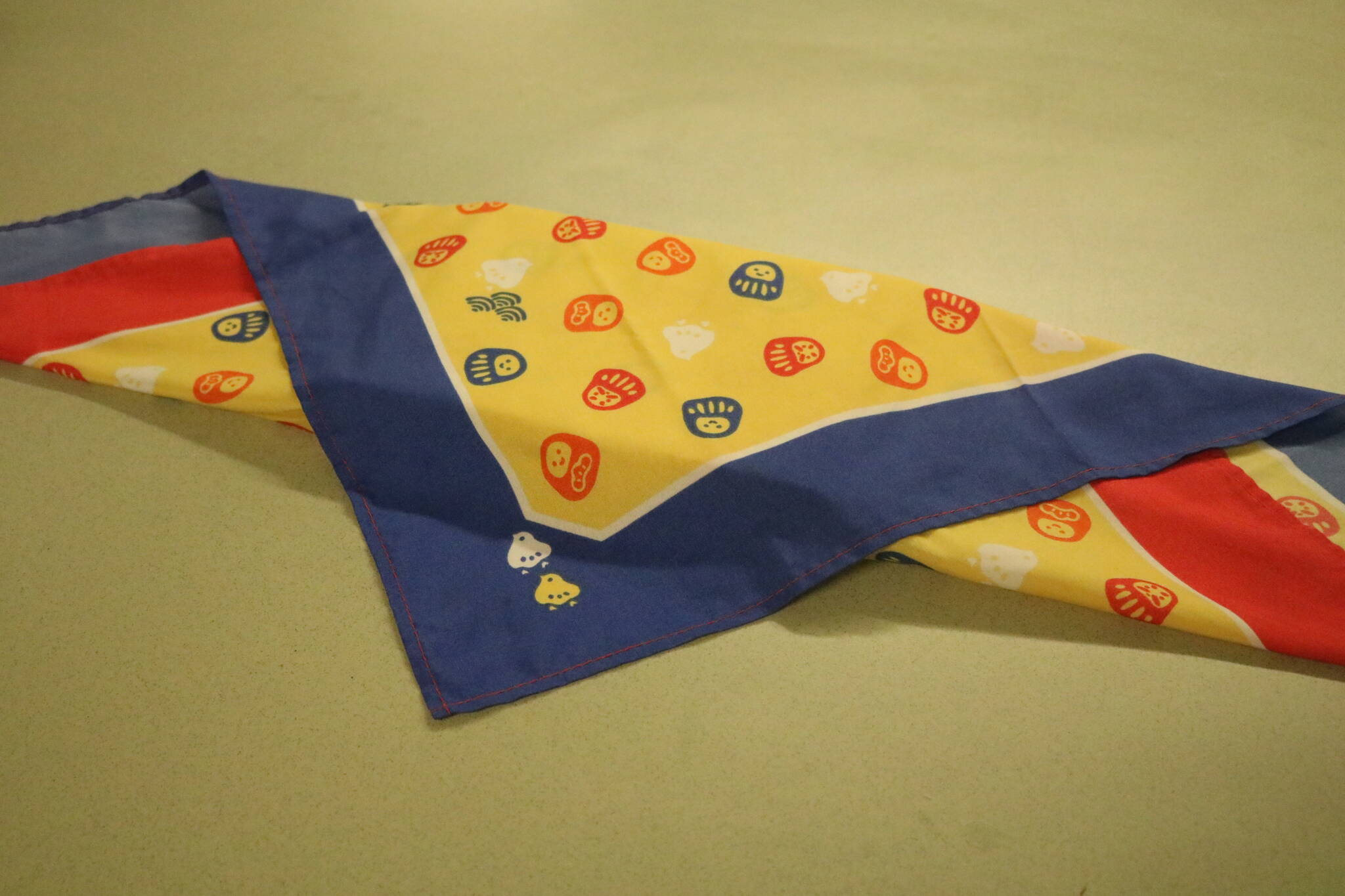
Photos by Bailey Jo Josie/Sound Publishing.
With the top and bottom corners of the diamond wrapped around the gift, you then take the left and right corners into each hand and then neatly tie a square knot (or ma-musubi) over the center of the gift. Adjust as needed to make the wrapping secure and aesthetically pleasing.
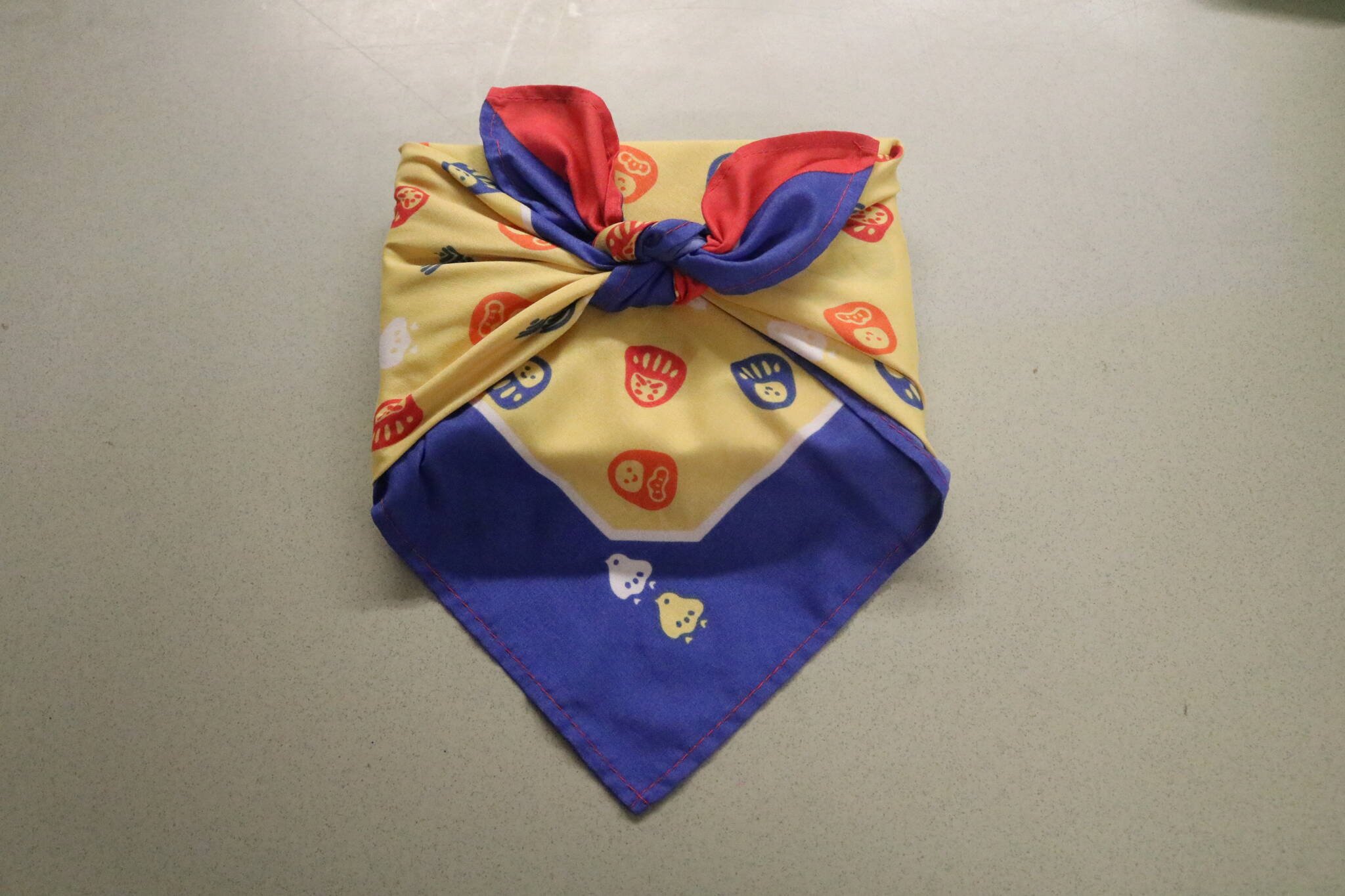
Photos by Bailey Jo Josie/Sound Publishing.
If you do not like the look of a square knot, one alternative is to use a hair tie or scrunchy to secure the corners of the furoshiki. Miyauchi suggests experimenting with tucking and folding the corners back into the elastic, making a bow or flower detail, no tying necessary.
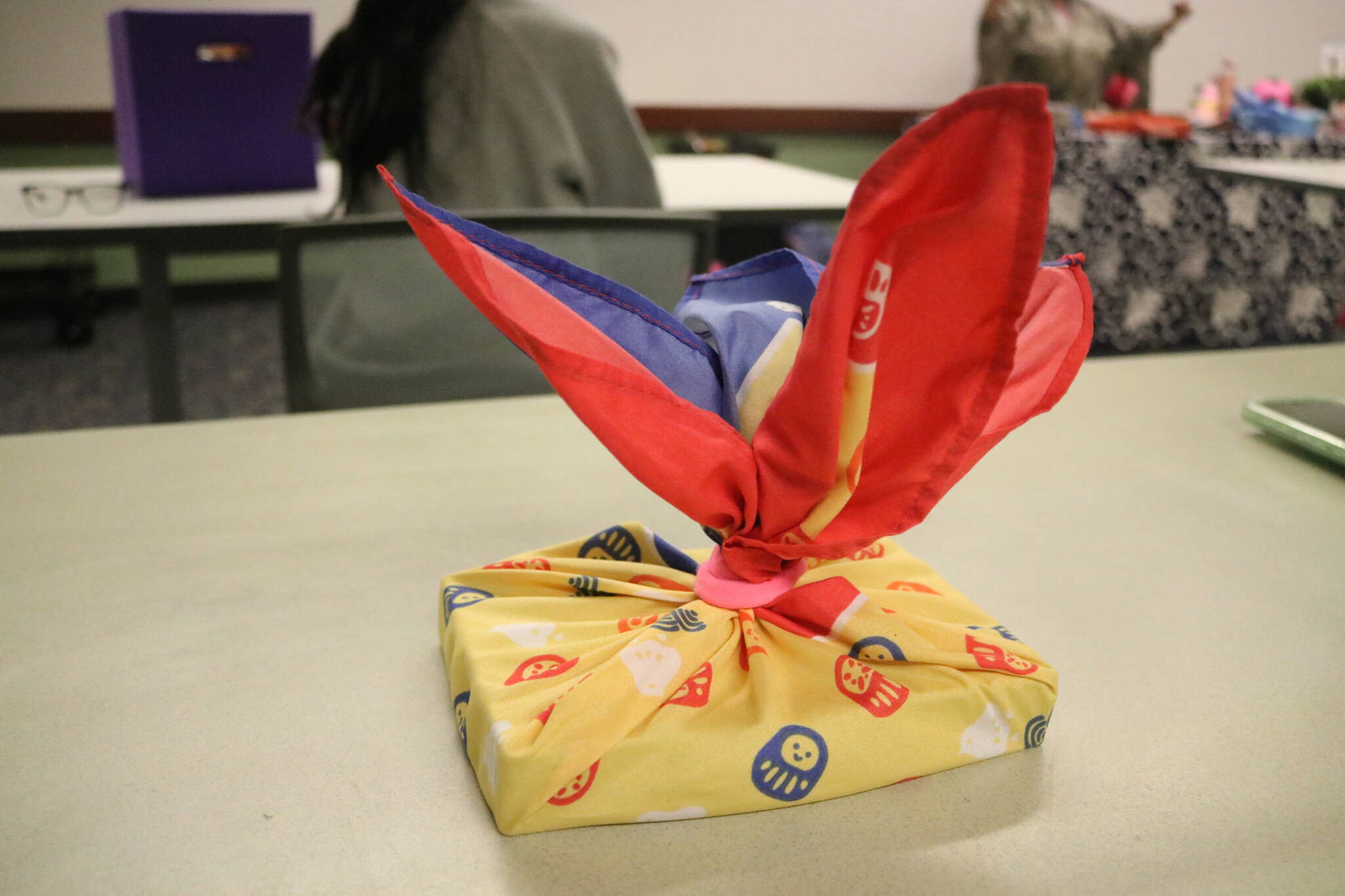
Photos by Bailey Jo Josie/Sound Publishing.
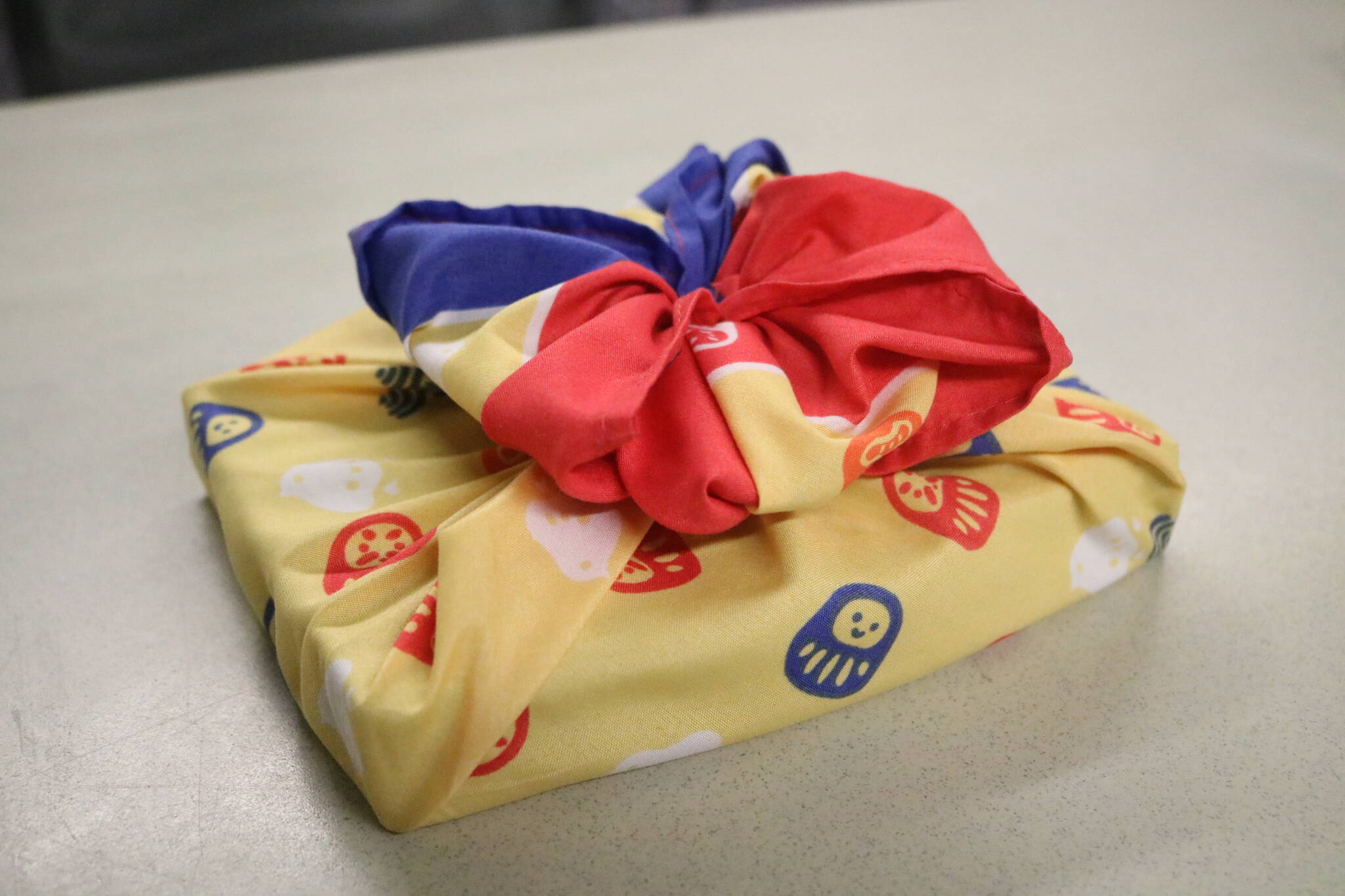
Photos by Bailey Jo Josie/Sound Publishing.
For a more thorough how-to, scan the QR code for a video tutorial:

For a more thorough how-to, scan the QR code for a video tutorial.
More furoshiki uses for gift-wrapping and item carrying
Image courtesy of the Ministry of the Environment of the Government of Japan.