McGraw-Hill focuses on digital offerings
Published 7:35 pm Monday, December 14, 2009
According to the company Web site, major publisher The McGraw-Hill Companies Inc., have been in business since 1909.
Director of product development in McGraw-Hill’s Bothell offices, Polly Stansell said one goal of the well-known firm is to grow its digital or Web-based educational offerings.
Hoping to draw on Northwest talent and know-how, McGraw-Hill launched its new Center for Digital Innovation over the summer.
A senior vice-president for McGraw-Hill Education and head of the still new and growing center, Randall Reina added the Puget Sound’s highly computer-literate work force was not the only factor that drew his company to this area.
“There’s a sense of entrepreneurship that’s important to us,” he said.
Reina likes the “start-up mentality” he believes is on display locally. “We’re very happy about being in this area.”
“It’s definitely been a benefit for us to have been out here,” Stansell said.
With plans for growth, the center employs 55 people including Web designers, graphic artists and data-base engineers, among others. The complex includes its own audio studio.
“We’re very proud of the software development process that we use,” Reina said.
For now, that process has led to three primary products, all geared toward K-12 grade schools.
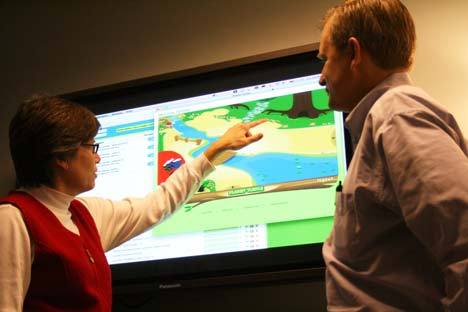
Reina said Planet Turtle is aimed at the youngest students, stealthily teaching math principles in essentially the form of a video game. In fact, Reina thinks Planet Turtle might be the first product of its kind to fully make use of video-game sensibilities.
Basically, students create their own turtle which then moves through different worlds, solving math-related challenges and earning points for individual players and their schools. Just as in video games, as the turtles advance and the points mount, more areas and worlds become accessible.
Stansell said one important point is that teachers control the curriculum. As students play the game, the instructors decide what skills they want those students to learn. Stansell also talked about Planet Turtle containing different kinds of games, from time-based to strategy, allowing students to pick whatever sort of challenge attracts them.
Planet Turtle launched in September in three languages: English, Spanish and Mandarin Chinese.
“That’s a really good example of the kinds of product we want to build,” Reina stated.
With the goal of teaching math in a new way to kindergarten through sixth-graders, Cinch Mathematics still is under development. Stansell said Cinch is intended to fill what McGraw-Hill sees as a gap in instructional software. She said while lots of schools make use of whiteboards, there is not a lot of programming available for those boards. Among other features, Cinch Math has an Internet component and student-response devices.
The center’s third offering is Cinch Project that allows students and instructors to collaborate on various types of academic work. Stansell said one idea behind Cinch Project is to allow teachers to better monitor student involvement with group projects. She asserted that traditionally one problem with such an educational approach was that some students ended up doing more of the work than others.
For the future, both Reina and Stansell talked of expanding the existing product line into other academic areas and grade levels. Reina said all of the center’s products have and will continue to draw on McGraw-Hill’s existing educational and curriculum expertise. But the company also wants to integrate the types of technology students are used to using every day, especially as more and more schools become wired to make use of that technology.
While the digital center represents a major push into electronic academic materials, McGraw-Hill does have previous experience with such products on which it can draw. Previous offerings include Everyday Math and Open Court Reading. As with Planet Turtle, Reina wants future McGraw-Hill offerings to allow customization of the curriculum.
“That’s an important focus for us,” he said.
If the digital center is new, McGraw-Hill has had a presence in Bothell since 2000. While he said the company intends for the center to grow, Reina didn’t offer any details. Still, Stansell also spoke of growth, adding that growth is a sign of McGraw-Hill’s commitment to nonprint educational tools.